-
-
-
-
Honor

-
-
-
-
-
Contact

-
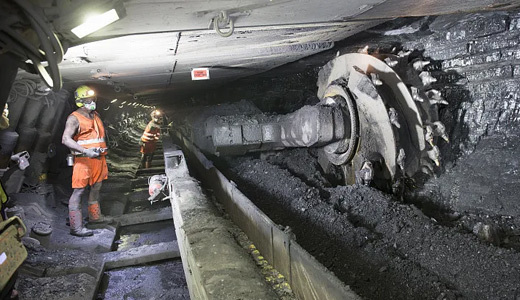







From perforation, blasting to soil discharge, an article to understand the six processes of open-pit mining.
Release time:
2020-03-03
Author:
Source:
The mining process of open-pit mines is relatively simple, mainly including perforation, blasting, mining, loading and transportation, and rock drainage. Next, we will talk about the mining technology of open pit mines.
1. perforation work
Perforation work is the primary process of open-pit mining. In the whole process of open-pit mining, the perforation cost accounts for about 10%-15% of the total production cost.
1. DTH Drill
The drilling angle of the down-the-hole drilling rig has a large range of changes and a high degree of mechanization, which reduces the auxiliary operation time and improves the operation rate of the drilling rig. Moreover, the down-the-hole drilling rig is flexible in mobility, light in weight and low in investment cost. In particular, the ore grade can be controlled by drilling various inclined holes, which can eliminate the foundation, reduce large blocks and improve the blasting quality. Therefore, the down-the-hole drilling rig is widely used in small and medium-sized mines at home and abroad, and is suitable for medium-hard rock perforation.
2. Cone wheel drill
The tooth wheel drilling machine is a new type of modern drilling equipment developed on the basis of rotary drilling machine, which has the characteristics of high perforation efficiency, low operation cost, mechanization and high degree of automation, and is suitable for the perforation operation of various hardness of ore rock. At present, it has become the perforation equipment widely used in open-pit mines all over the world.
3. Rock drilling jumbo
Rock drilling rig is a new type of rock drilling equipment with the development of mining industry. It is to install one or several rock drills together with automatic thrusters on a special drilling arm or bench, and has a walking mechanism to mechanize the rock drill operation.
2. blasting work
The purpose of blasting work is to break the hard solid ore rock and provide suitable excavated materials for mining and loading work. In the total cost of open pit mining, blasting costs account for about 15%-20%. The quality of blasting not only directly affects the efficiency of mining, transportation, coarse crushing and other equipment, but also affects the total cost of the mine.
1. Shallow hole blasting
The diameter of the blasthole used in shallow hole blasting is small, generally about 30-75mm, and the depth of the blasthole is generally below 5 meters, sometimes up to about 8 meters. If the drilling is carried out by a rock drilling rig, the depth of the hole can be increased. Shallow hole blasting is mainly used for the production of small-scale open-pit mines or quarries, caverns, tunnel excavation, secondary blasting, new open-pit mine package treatment, hillside open-air single-wall ditch transport path formation and other special blasting.
2. Deep hole blasting
Deep hole blasting is a blasting method that uses drilling equipment to drill deeper holes as a charge space for mining explosives. The deep hole blasting of open pit mine is mainly based on the production blasting of steps. The drilling equipment for deep hole blasting is mainly used in down-the-hole drill and tooth wheel drill. Its drilling can drill vertical deep hole, also can drill inclined gun hole. The charge of the inclined blast hole is more uniform, and the blasting quality of the ore rock is better, which creates good conditions for the mining and loading work. In order to reduce the seismic effect and improve the blasting quality, under certain conditions, measures such as large area millisecond blasting, interval charging in the hole or bottom air interval charging can be taken in order to reduce the blasting cost and obtain better economic benefits.
3. Chamber blasting
Chamber blasting is a method of blasting in which more or a large amount of explosives are installed in the blasting chamber roadway. Open pit mines are only used during the capital construction period and under certain conditions, and quarries are used when conditions are available and when mining demand is high.
4. Multi-row hole differential blasting method
In recent years, with the rapid increase of excavator bucket capacity and open-pit mine production capacity, the amount of blasting required for normal mining blasting in open-pit mines is also increasing, for this reason, large-scale blasting methods such as multi-row hole differential blasting and multi-row hole differential extrusion blasting are widely used in open-pit mining at home and abroad.
5. Multi-row hole differential extrusion blasting method
Refers to the multi-row hole millisecond blasting under the condition of residual blasting pile in the working face. The existence of ballast pile creates conditions for extrusion, on the one hand, it can prolong the effective action time of blasting, improve the utilization and crushing effect of explosive energy, on the other hand, it can control the width of blasting pile and avoid the scattering of ore rock. The interval time of multi-row hole differential extrusion blasting is 30% ~ 50% larger than that of ordinary differential blasting, and 50~100ms is often used in open pit mines in China.
The advantages of multi-row hole millisecond extrusion blasting are:
(1) the effect of rock crushing is better. This is mainly because there is a slag pile blocking in front, and each row of drilling holes including the first row can increase the charge and fully crush under the extrusion of the slag pile;
(2) The explosive pile is more concentrated. For mines transported by rail, the road may not be dismantled before blasting, so as to improve the efficiency of mining, loading and transportation equipment.
Disadvantages of multi-row hole millisecond extrusion blasting are:
(1) Large explosive consumption;
(2) The working platform is required to be wider to accommodate the ballast pile;
(3) The height of the explosive pile is large, which may affect the safety of the excavator operation.
Blasting Measures for 3. Adjacent Slope
With the downward extension of open-pit mine, the problem of slope stability has become increasingly prominent. In order to protect the slope, the blasting near the slope should be strictly controlled. According to the experience at home and abroad, the main measures are to use millisecond blasting, pre-splitting blasting and smooth blasting.
1. Use millisecond blasting to reduce vibration
One of the main functions of millisecond blasting is to reduce the seismic effect of blasting. In order to give full play to the damping effect of differential blasting, the key is to try to increase the number of blasting segments and control the differential interval time.
2. Slope isolation by pre-splitting blasting
The pre-splitting blasting near the slope is to drill a row of dense parallel holes along the slope boundary, each hole is filled with a small amount of explosive, and the blasting is started before the mining belt is not blasted, so as to obtain a crack with a certain width and through each hole. Because of this pre-crack will be separated from the mining belt and slope, then the seismic wave of mining blasting will produce strong reflection on the crack surface, so that the seismic wave through it is greatly weakened, thus protecting the slope.
3. Slope protection by smooth blasting
The smooth blasting near the slope is to drill a row of dense parallel boreholes along the boundary line, fill the holes with a small amount of explosives, and then blast after the mining borehole blasting, thus forming parallel rock walls along the dense boreholes. The difference between smooth blasting and pre-splitting blasting is mainly in the initiation time. The initiation of the smooth hole is later than the previous rows of mining holes, usually with a lag of 50~75ms. In addition, there is a measure to control the blasting of the last few rows of holes. The amount of the last few rows of drilling near the slope and the resistance line should be reduced, which is called "buffer blasting", which can reduce the damage to the slope by drilling blasting.
4. loading and transportation
Mining and loading
Mining and loading operation is to use loading machinery to excavate ore rock directly from underground or explosive pile, and load it into the carriage of transportation machinery or directly discharge it to the designated place. It is the central link in the open-pit mining process, and other production processes such as blasting and transportation are used for mining and loading.
Main mining and loading equipment: excavators, draglines, hydraulic shovels and tire-type front-mounted machines.
Transportation
In the process of open-pit mining, the capital construction investment of mine transportation accounts for about 60% of the total investment of mine infrastructure, and the transportation cost and labor amount account for more than half of the total cost of ore and total labor amount respectively, which shows the important position of transportation in open-pit mining.
Open-pit mine transportation mode: automobile transportation, railway transportation, belt transportation, slope skip lifting transportation and combined transportation mode, among which dump truck transportation is the most common.
Mining and transportation are inseparable, and they influence and restrict each other. At present, the development trend of mining and transportation technology is mainly reflected in the large-scale mining and transportation equipment, the integration and continuity of mining and transportation links, and computer automation.
5. row rock
Rock drainage is the operation of the transportation terminal, which transports the stripped topsoil and waste rock to the waste rock yard for disposal.
Rock drainage technology: railway transportation, highway transportation and belt transportation.
6. dump
Drain yard (waste rock yard): The place where stripped materials are piled up refers to the place where the mining waste materials are concentrated and discharged.
According to the stacking sequence, the dump can be divided into: single-step dump, covered multi-step dump, and foot-pressing multi-step dump.
The dump is mainly divided into highway transportation dump, railway transportation dump, belt transportation dump and hydraulic transportation dump according to the dump technology.
This article reproduced from the drilling machine network, infringement will be deleted!
Key words: