-
-
-
-
Honor
-
-
-
-
-
Contact

-







Analysis of the causes of damage to the down-the-hole drill bit-Yiguang Technology
Release time:
2020-03-03
Author:
Source:
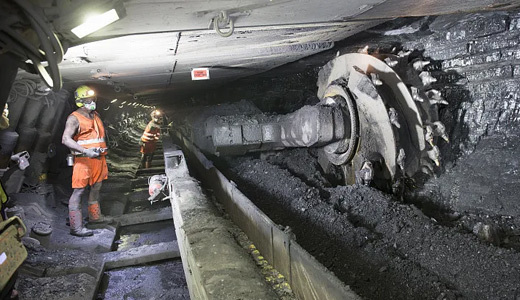
Mud ring wrapping Mud ring wrapping means that rock powder (chips) adheres to the surface of the drilling tool or the borehole wall to form a mud ring and wrap the drilling tool. After the mud ring is formed, the annular space becomes smaller and the debris removal is not smooth, and the debris continues to gather at the mud ring to form a mud bag, which completely blocks the borehole in severe cases, causing sticking and burying accidents. Cause analysis of formation factors: micro-water gushing and wet formation, formation micro-water gushing in the well wall to form a liquid film and make rock powder wet, well wall liquid film and rock powder bond each other to form a cuttings group, the cuttings group can not be completely taken out of the well shaft by air at the well wall, hammer head adhesion to form a mud ring, and mud group adhesion to form a mud ring phenomenon is particularly serious. Solution (1) replace the drilling process.
Mud ring wrap
Mud ring wrapping means that the rock powder (cuttings) adheres to the surface of the drilling tool or the borehole wall to form a mud ring and wrap the drilling tool. After the mud ring is formed, the annular space becomes smaller and the debris removal is not smooth, and the debris continues to gather at the mud ring to form a mud bag, which completely blocks the borehole in severe cases, causing sticking and burying accidents.
cause analysis
Formation factors: micro-gushing water and wet formation. The formation micro-gushing water forms liquid film on the borehole wall and makes rock powder wet. The liquid film on the borehole wall and rock powder bond to form rock cuttings. When the rock cuttings cannot be completely taken out of the wellbore by air, they adhere and gather at the borehole wall and hammer head to form mud rings, and the phenomenon of mud mass adhering and gathering into mud rings is particularly serious.
Solution measures
(1) Replace the drilling process. When the formation is wet and a small amount of water seepage is encountered during drilling, the limestone, dolomite and other rock formations are drilled by atomization (diluted by water injection).
(2) Discharge chips frequently. For every 0.5~1m of drilling, the drilling tool is pulled away from the bottom of the well for slag discharge.
(3) increase the air compressor. Increase the air supply, improve the wind speed, enhance the sand discharge effect.
(4) Reasonable allocation of drilling tools. Select reasonable drill collar and drill pipe.
(5) Short-range trip to draw the borehole wall. Prevent the forming and thickening of the mud ring on the shaft wall.
6. Card and buried drill
Stratigraphic factors: geologic structure, dissolution, cracks produced by joints and development of faults lead to loose rock mass and weak bonding force, as well as water inflow which leads to water-absorbing expansion and disintegration of some rock strata, well wall falling off, collapse and burying down-the-hole hammer. Process technology: drilling medium and high frequency shock destroys the overall structure of rock mass, high-speed airflow scouring (stripping) destroys the rock wall structure, circulating medium has no balanced wall protection function, and water gushing soak reduces the structural force of mud shale to cause block sticking hammer head and collapse buried down-the-hole hammer.
Technical measures
(1) Observe frequently.
(2) Operate drilling tools frequently.
(3) Timely stop drilling.
(4) channeling and unblocking.
(5) Infusion of foam agent for strong chip removal and resistance removal.
(6) Short-rise the borehole wall.
(7) foam drilling.
(8) Replace the process protection wall and drill.
(9) Mud injection for wall protection.
(10) Milling card.
Key words:
Cause, borehole, formation, drilling, formation, moist, cuttings, structure, retaining wall, wrap